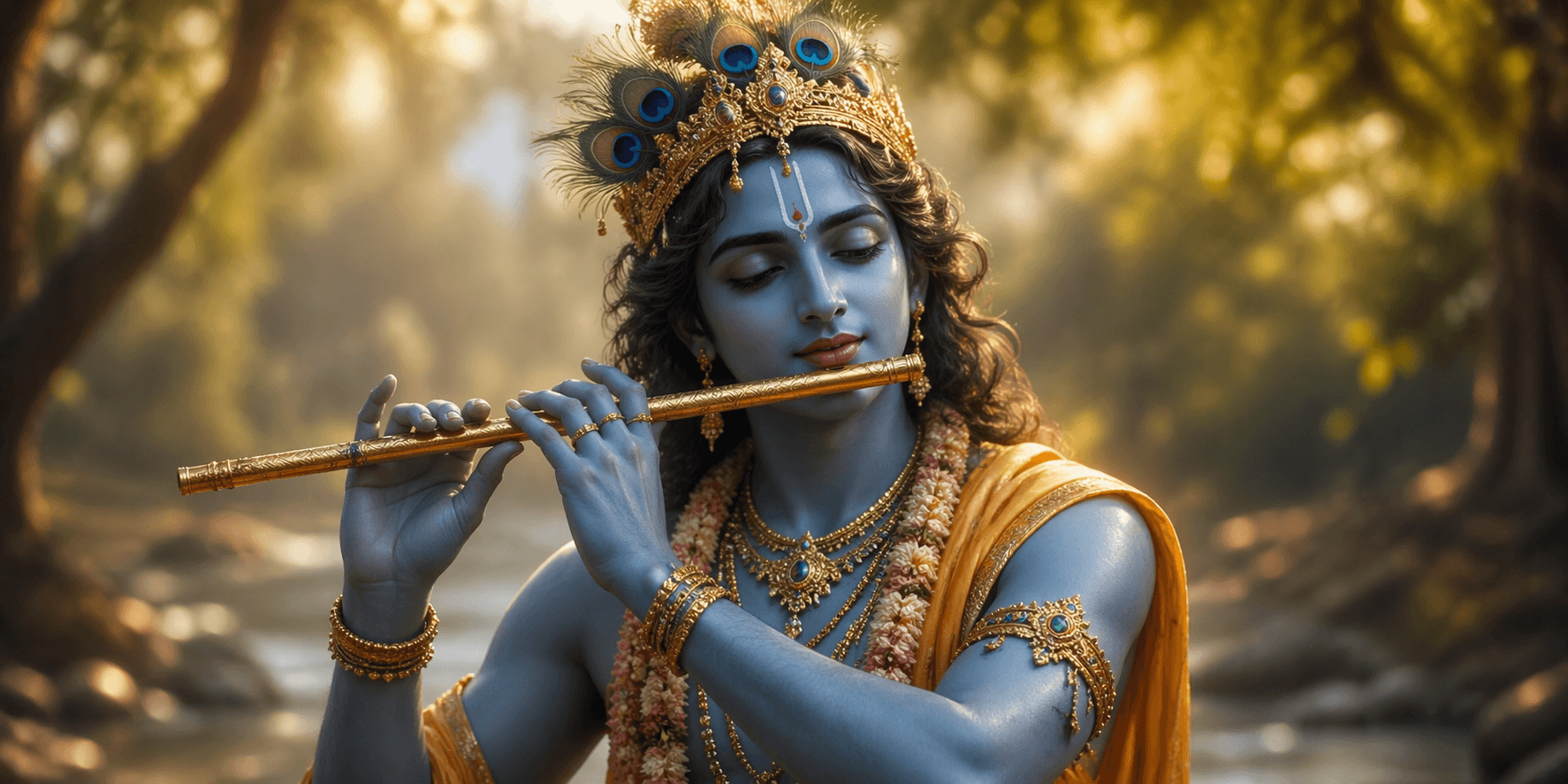
The eighth avatar of Vishnu, known for his teachings in the Bhagavad Gita and his divine play (leela) in Vrindavan.
About Lord Krishna
Lord Krishna is the eighth and most celebrated avatar of Lord Vishnu, revered as the supreme deity in Hindu tradition. Known for his divine teachings in the Bhagavad Gita and enchanting childhood stories in Vrindavan, Krishna represents the perfect blend of divine love, wisdom, and cosmic power. His life encompasses miraculous birth stories, playful butter-stealing episodes, profound philosophical discourse, and his pivotal role in the Mahabharata war. Born in Mathura to Devaki and Vasudeva, Krishna's arrival was prophesied to end the tyrannical rule of his uncle Kamsa. His childhood in Vrindavan with foster parents Yashoda and Nanda became the foundation for countless devotional traditions. The cowherd boy who enchanted the gopis with his flute later emerged as the divine charioteer who revealed ultimate spiritual truths to Arjuna on the Kurukshetra battlefield. Krishna's significance transcends regional boundaries, inspiring diverse worship forms from ISKCON's global movement to traditional temple rituals across India. His relationship with Radha symbolizes the soul's eternal quest for divine union, while his philosophical teachings in the Bhagavad Gita provide timeless guidance on duty, devotion, and self-realization. Major festivals like Janmashtami and Holi celebrate different aspects of his divine nature. The iconography of Krishna—depicted with his characteristic peacock feather crown, flute, and blue complexion—appears in countless temples from Dwarkadheesh to Banke Bihari. His 108 sacred names reflect various aspects of his personality, from Govinda (protector of cows) to Madhava (sweet like honey). Archaeological evidence from Mathura and literary references in ancient texts like the Vishnu Purana and Bhagavata Purana establish Krishna's deep historical and spiritual significance in Hindu civilization.
Divine Attributes
Sacred Stories & Legends
Discover 10 fascinating stories that reveal the divine qualities and teachings of Lord Krishna.
Who is Lord Krishna and what makes him special in Hinduism?
Lord Krishna is the eighth avatar of Vishnu, considered the complete manifestation of divinity who appeared on Earth to restore dharma and guide humanity through his teachings and divine play.
Lord Krishna stands as the most beloved deity in Hinduism, revered not merely as an avatar but as Svayam Bhagavan - the original form of God himself. According to the Bhagavata Purana, Krishna's incarnation was specifically designed to demonstrate how divinity can manifest in human form while retaining complete cosmic consciousness. The Vishnu Purana establishes Krishna as the eighth avatar in the sequence of Vishnu's earthly appearances, yet devotees consider him unique among all avatars. Unlike other avatars who appeared for specific purposes, Krishna's life encompassed the full spectrum of human experience - from playful childhood to wise teacher, from romantic lover to fierce warrior. Krishna's birth in Mathura prison to Devaki and Vasudeva fulfilled ancient prophecies about a divine child who would end Kamsa's tyranny. The miraculous circumstances of his birth - including the sleeping guards and opening prison doors - established his divine nature from the beginning.
Krishna as the Complete Avatar of Vishnu
Krishna represents Vishnu's complete incarnation, possessing all sixteen divine qualities (kala) unlike partial avatars.
The Brahma Vaivarta Purana explains that while other avatars manifest specific aspects of divinity, Krishna possesses all sixteen kala - the complete divine attributes. This makes him Purna Avatar, the full manifestation of cosmic consciousness. Devotees worship him simultaneously as the cosmic creator, the playful child, and the wise teacher, recognizing his ability to be completely human while remaining utterly divine.
Krishna's Universal Appeal Across Hindu Traditions
Krishna transcends sectarian boundaries, attracting devotion from Vaishnavas, Shaivites, and secular followers worldwide.
Unlike deities associated with specific traditions, Krishna's appeal spans all Hindu denominations. Shaivite saints like Adi Shankara composed devotional hymns to Krishna, while Vaishnavite traditions consider him the supreme deity. Modern movements like [ISKCON] have spread Krishna consciousness globally, while traditional practices in Vrindavan and Mathura continue ancient worship methods established over 5,000 years ago.
What are the most famous stories from Krishna's childhood in Vrindavan?
Krishna's childhood stories in Vrindavan include butter-stealing episodes, lifting Govardhan hill, and his enchanting flute playing that captivated the gopis, demonstrating his divine nature through playful miracles.
The butter-stealing stories (Makhan Chor tales) from the Bhagavata Purana reveal Krishna's mischievous yet divine nature. Young Krishna would organize elaborate schemes with his friends to steal butter from neighboring houses, displaying supernatural abilities like walking on walls and appearing in multiple places simultaneously. The most celebrated childhood miracle occurred when Krishna lifted Govardhan Hill on his little finger for seven consecutive days. When Indra sent torrential rains to punish the villagers for worshipping Govardhan instead of him, five-year-old Krishna effortlessly held the massive hill as an umbrella, protecting all of Vrindavan's inhabitants and cattle. Krishna's flute playing created an irresistible divine attraction that drew not only the gopis but all living beings in Vrindavan. The Gita Govinda describes how his melodious tunes would make cows stop grazing, birds fall silent, and even the Yamuna river slow its flow to listen.
The Govardhan Hill Lifting Miracle
Krishna's lifting of Govardhan Hill demonstrated his divine power while teaching villagers about true devotion over ritualistic worship.
The Vishnu Purana records that Govardhan Puja replaced Indra worship after this miracle, establishing a new tradition still celebrated annually. Krishna's action taught that sincere devotion to local deities and nature holds more spiritual value than elaborate ceremonies to distant gods. This story occurs when Krishna was merely seven years old, yet he sustained the enormous hill effortlessly while playing and eating normally.
Krishna's Divine Play with the Gopis
The gopis' love for Krishna represents the soul's yearning for divine union, expressed through dance, music, and spiritual devotion.
The Rasa Lila dance described in the Bhagavata Purana shows Krishna multiplying himself to dance simultaneously with each of the 16,000 gopis, ensuring none felt neglected. This divine play occurs on full moon nights in Vrindavan, where Krishna's flute calls the gopis from their homes to participate in transcendental love that symbolizes the individual soul's relationship with the supreme consciousness.
What is Krishna's role and significance in the Bhagavad Gita?
In the Bhagavad Gita, Krishna serves as Arjuna's charioteer and spiritual teacher, revealing profound truths about duty, devotion, and self-realization during the Kurukshetra war.
Krishna's discourse in the Bhagavad Gita represents the pinnacle of Hindu philosophical teaching, delivered on the battlefield of Kurukshetra when Arjuna faced moral crisis about fighting his relatives. As Arjuna's charioteer and guide, Krishna transformed from friend to divine teacher, revealing his cosmic form and eternal truths. The Bhagavad Gita's eighteen chapters contain Krishna's systematic explanation of three paths to liberation: Karma Yoga (path of action), Bhakti Yoga (path of devotion), and Jnana Yoga (path of knowledge). His teaching that one should perform duty without attachment to results became fundamental to Hindu ethics and philosophy. Krishna's revelation of his Vishvarupa (universal form) in Chapter 11 demonstrated his cosmic nature to Arjuna, showing him the entire universe within his divine body. This theophany established Krishna as not merely an avatar but as the supreme cosmic consciousness itself.
Krishna's Teaching on Dharma and Duty
Krishna taught Arjuna that righteous duty must be performed without attachment to results, establishing the principle of Nishkama Karma.
The concept of Nishkama Karma - desireless action - became Krishna's core teaching in the Gita. He explained that liberation comes not from avoiding action but from performing one's dharmic duty without ego or attachment to outcomes. This principle applies to all life situations, from warrior's duty in battle to householder's responsibilities, making the Gita relevant across all social roles and time periods.
Krishna's Universal Form Revelation
Krishna's cosmic form showed Arjuna the divine reality underlying all existence, proving his identity as the supreme godhead.
In the Vishvarupa Darshan, Arjuna witnessed Krishna's infinite cosmic form containing all deities, beings, and universes simultaneously. This vision terrified and amazed Arjuna, who saw the past, present, and future unfolding within Krishna's divine body. The experience convinced Arjuna of Krishna's supreme nature and the necessity of surrendering completely to divine will in all circumstances.
How is Lord Krishna worshipped in different Hindu traditions?
Lord Krishna is worshipped across Hindu traditions through devotional practices that include chanting the Krishna god mantra, offering flowers and tulsi leaves, and reciting prayers at dawn and dusk. Different schools of Vaishnavism, such as the Gaudiya tradition and the Sri Sampradaya, each have their own ritual frameworks and sacred texts guiding this worship. Common to nearly all traditions is the centrality of bhakti, or loving devotion, as the highest path to experiencing Krishna's divine grace.
Traditional Vaishnavite worship of Krishna centers around the temples of Mathura, Vrindavan, and Dwarka, where priests follow ancient rituals established in the Pancharatra Agamas. Daily worship includes elaborate arati ceremonies, offering of 56 food items (Chappan Bhog), and recitation of the Bhagavata Purana. The ISKCON movement, founded by A.C. Bhaktivedanta Swami Prabhupada in 1966, has globalized Krishna worship through the Hare Krishna Mahamantra. ISKCON temples worldwide follow Gaudiya Vaishnavite traditions, emphasizing personal relationship with Krishna through devotional service (bhakti-yoga). Regional traditions show remarkable diversity: Bengali devotees celebrate Krishna through Kirtans and Baul songs, South Indian temples like Guruvayur maintain strict ritual traditions, while Gujarati communities focus on Krishna's childhood through elaborate Janmashtami celebrations with human pyramids (Govinda) recreating butter-stealing stories.
Temple Worship and Daily Rituals
Traditional Krishna temples follow prescribed daily schedules of worship including multiple arati ceremonies, food offerings, and scriptural recitations.
Krishna temples maintain eight-fold daily worship schedule (Ashtayam Seva) beginning before dawn with Mangala Arati. The deity receives regular meals, clothing changes, and rest periods, treating Krishna as a living presence. Famous temples like Banke Bihari in Vrindavan and Dwarkadhish in Gujarat preserve centuries-old ritual traditions with specific hymns, instruments, and offerings unique to each location.
Modern Global Krishna Movement
ISKCON and other modern movements have adapted traditional Krishna worship for contemporary global audiences while maintaining scriptural authenticity.
The Hare Krishna movement operates over 850 temples worldwide, translating classical texts like Bhagavad Gita and Srimad Bhagavatam into numerous languages. Modern devotees practice Krishna consciousness through vegetarianism, daily chanting of 16 rounds of Hare Krishna Mahamantra, and community-based spiritual living. This globalization has introduced millions to Krishna worship while maintaining traditional philosophical foundations established by medieval saints like Chaitanya Mahaprabhu.
What are Krishna's most important names and their spiritual meanings?
Krishna's 108 sacred names each reveal different aspects of his divine nature, from Govinda (protector of cows) to Madhava (sweet like honey), with each name carrying specific spiritual significance and worship benefits.
The Vishnu Sahasranama and Krishna Ashtottara Shatanamavali contain Krishna's most powerful names, each representing specific divine attributes. Govinda emphasizes his role as protector of cows and the earth, while Gopala highlights his identity as the divine cowherd who tends to devotees like a loving shepherd. Madhava (sweet like honey) refers to Krishna's irresistible attractiveness that draws souls toward divine consciousness. Vasudeva identifies him as Vasudeva's son while also meaning "he who dwells everywhere," indicating his omnipresent nature. Damodara (rope around waist) recalls the childhood story when Yashoda tied him up, representing how divine love can bind even the supreme godhead. The name Hrishikesha (master of the senses) appears in the Bhagavad Gita, indicating Krishna's power to control both cosmic forces and individual consciousness. Achyuta (infallible one) emphasizes his eternal nature that never falls from divine status, while Janardana (liberator of people) highlights his role as humanity's spiritual savior.
Names Related to Krishna's Divine Childhood
Krishna's childhood-related names like Damodara, Makhan Chor, and Bala Gopala capture his playful divine nature and intimate relationship with devotees.
Damodara specifically refers to the rope (dama) around Krishna's waist when Yashoda tied him to a grinding stone. This name appears in the Damodarashtakam, sung during the sacred month of Kartik. Makhan Chor (butter thief) represents how Krishna steals devotees' hearts through his enchanting childhood activities. These intimate names allow devotees to approach the supreme deity through parental love (vatsalya bhava) rather than formal reverence.
Cosmic Names Revealing Krishna's Universal Nature
Names like Vishnu, Narayana, and Purushottama reveal Krishna's identity as the supreme cosmic consciousness beyond his human form.
Purushottama (supreme person) establishes Krishna as the ultimate reality beyond both kshara (perishable) and akshara (imperishable) beings. The Bhagavad Gita uses this name to indicate Krishna's transcendental position. Narayana connects him to the cosmic Vishnu lying on the serpent Shesha, while Hari (one who removes obstacles) emphasizes his power to eliminate spiritual ignorance and material suffering from devotees' lives.
Frequently Asked Questions about Lord Krishna
Is Lord Krishna a Hindu god?▼
Yes, Lord Krishna is one of the most important deities in Hinduism, worshipped as the eighth avatar of Vishnu and considered the complete manifestation of divine consciousness. He is central to major Hindu scriptures like the Bhagavad Gita and Bhagavata Purana.
Who kissed Radha first?▼
According to traditional Hindu scriptures, the relationship between Krishna and Radha represents pure spiritual love rather than physical romance. Their divine love story in texts like Gita Govinda symbolizes the soul's yearning for union with the supreme consciousness.
Who did Radha love the most?▼
Radha's supreme love was devoted entirely to Krishna, representing the pinnacle of spiritual devotion in Hindu tradition. Their relationship symbolizes the individual soul's complete surrender and love for the divine, making Radha the ideal devotee in Vaishnavite philosophy.
Who was Vishnu avatar shown to Arjun?▼
Krishna revealed his cosmic form (Vishvarupa) as the supreme manifestation of Vishnu to Arjuna in Chapter 11 of the Bhagavad Gita. This universal form showed Krishna as the source of all creation, containing entire universes within his divine body.
What is the significance of Krishna's flute in Hindu worship?▼
Krishna's flute represents the divine call that attracts souls toward spiritual awakening and God-realization. The melodious sound symbolizes the irresistible pull of divine love that draws devotees away from material concerns toward transcendental consciousness.
Is Krishna the elephant god in Hinduism?▼
Krishna is not the elephant god in Hinduism — that is Ganesha, the beloved deity with an elephant head who removes obstacles. Krishna is instead the eighth avatar of Lord Vishnu, celebrated for his divine teachings in the Bhagavad Gita and his playful childhood in Vrindavan. Both Krishna and Ganesha are widely worshipped Hindu gods, but they are distinct deities with different forms, stories, and spiritual roles.
Who is Lord Krishna in Hinduism?▼
Lord Krishna is one of the most revered and beloved deities in Hinduism, considered the eighth avatar of Lord Vishnu. He is celebrated as a divine teacher, warrior, and philosopher, best known for delivering the sacred teachings of the Bhagavad Gita to the warrior Arjuna on the battlefield of Kurukshetra. Lord Krishna is worshipped across the world as a symbol of love, wisdom, and cosmic truth.
Who is Krishna in Hinduism?▼
In Hinduism, Krishna is one of the most widely revered and worshipped deities, considered the eighth avatar of the god Vishnu. Hinduism's Krishna is celebrated as a divine hero, philosopher, and teacher, most famously known for delivering the spiritual teachings of the Bhagavad Gita. He is a central figure in Hindu theology, embodying love, wisdom, and divine playfulness across countless sacred texts and traditions.
Is Krishna considered a god in Hinduism?▼
Yes, Krishna is considered a god in Hinduism and is one of the most widely revered deities in the religion. As a Krishna god figure, he is regarded as the eighth avatar of Lord Vishnu and is celebrated as a divine being of supreme power, wisdom, and love. Millions of devotees across the world worship Krishna god through prayer, song, and festival traditions rooted in ancient Hindu scriptures.
Is Krishna a Hindu god?▼
Yes, Krishna is a Hindu god and one of the most widely revered deities in Hinduism. As a Krishna Hindu god, he is considered the eighth avatar of Lord Vishnu and is celebrated for his divine teachings in the Bhagavad Gita. Millions of devotees across the world worship Krishna as a symbol of love, wisdom, and divine grace.
Who is the Hindu god Krishna?▼
The Hindu god Krishna is one of the most widely revered and celebrated deities in Hinduism, regarded as the eighth avatar of Lord Vishnu. He is known as the god of love, compassion, and divine wisdom, and his teachings are immortalized in the sacred text the Bhagavad Gita. The Hindu god Krishna is worshipped by millions across the world, especially during the festival of Janmashtami, which celebrates his birth.
Who is Krishna in Hinduism?▼
Krishna in Hinduism is one of the most widely revered and beloved deities, regarded as the eighth avatar of Lord Vishnu and a supreme being in his own right. In Krishna Hinduism traditions, he is celebrated as a divine teacher, warrior, and embodiment of love and compassion, most famously through his teachings in the Bhagavad Gita. He is central to major Hindu sects such as Vaishnavism and is worshipped by hundreds of millions of devotees around the world.
Sacred Mantras
1 availableDiscover powerful mantras for meditation and devotion
Explore Mantras